Lijjat Papad Business Model: The ₹1,600 Crore Company With No Boss
Seven homemakers borrowed ₹80 in 1959. Sixty-five years later, the Lijjat Papad business model runs on 45,000 women with no CEO, no hierarchy, and no ads. Here is how, and what it teaches us about ownership.
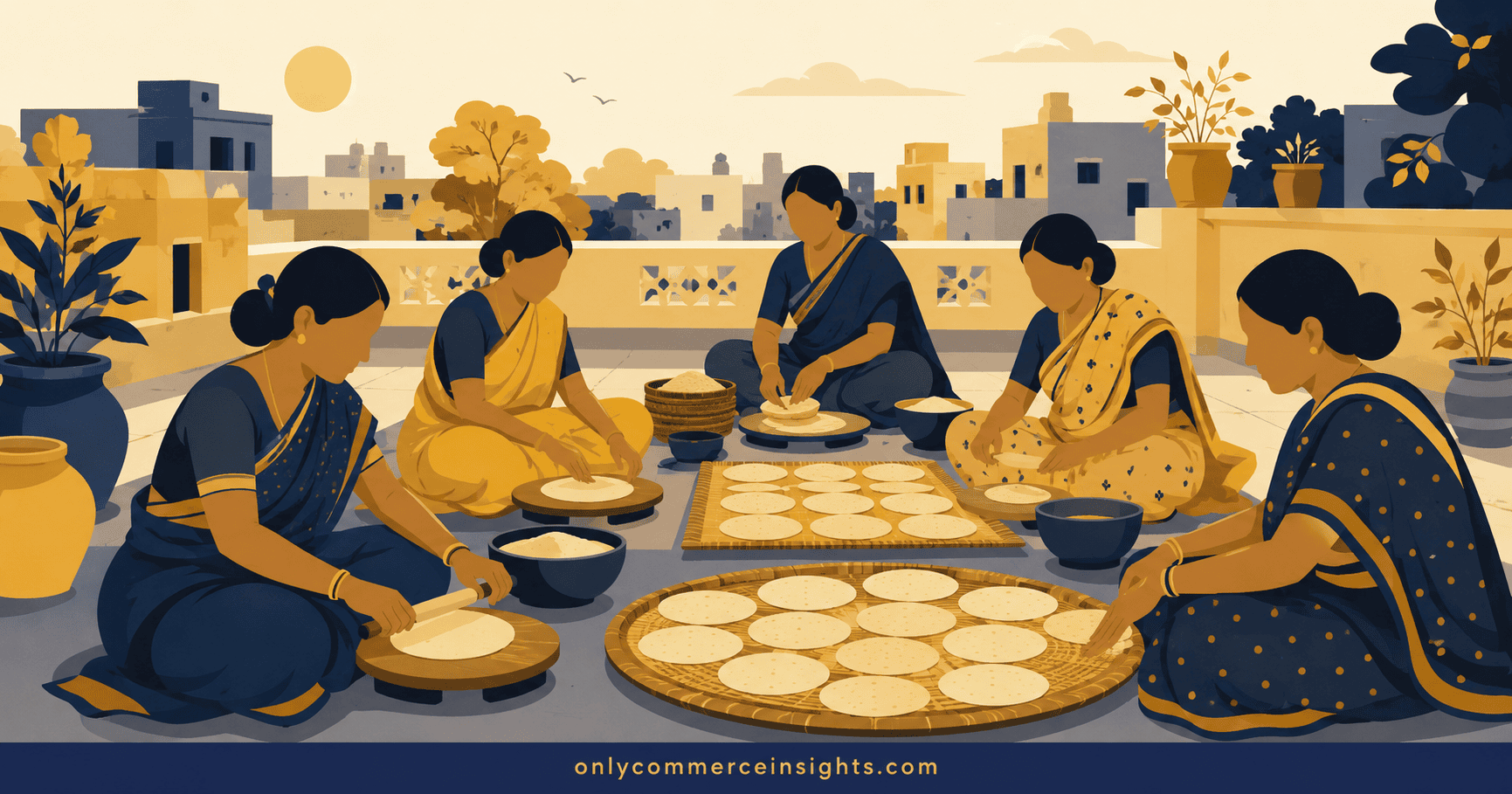
Seven Women, One Terrace, ₹80
In March 1959, on the terrace of a building in Girgaum, Mumbai, seven women sat down to make papad. What they built, without ever calling it this, would become one of the most unusual cooperative business models in India: no boss, no hierarchy, and a structure that still runs a ₹1,600 crore company today. They were not entrepreneurs in any sense the word carries now. They were homemakers who wanted a way to earn without leaving the house, in a decade when a woman working outside the home was still something families argued about behind closed doors.
They borrowed ₹80 from a local social worker. That is roughly ₹6,800 in today's money, less than what a first year MBA student spends on a week of mess food. With that, they took over a papad business that was already failing and started again, from nothing, on their own terms.
Their first year of sales came to ₹6,196. Nobody watching them roll dough on that terrace would have guessed they had just started something that would still be running two generations later, untouched by the founders who began it, unchanged in the thing that makes it work.
Inside the Lijjat Papad Business Model: The Part That Should Not Work, But Does
Here is where Lijjat stops being a nice story and becomes genuinely strange from a business standpoint. There is no owner. There is no CEO issuing targets. There is no manager standing over anyone's shoulder.
Every woman who joins is not hired, she is made a co-owner. They call each other "sisters," not employees. A woman who joined last month earns the same profit share as one who has been rolling papad for twenty years. Seniority buys respect, not extra money.
Big decisions do not come from the top. They come from a rotating committee of members reaching consensus. A woman known as a sanchalika coordinates each branch, but she cannot simply decide something and expect it to happen. She has to bring people along.
So What Actually Keeps 45,000 People Aligned?
This is the question that should be bothering you right now, because it bothered me too. No boss, no hierarchy, tens of thousands of people, and yet the papad you buy from a shop in Amritsar tastes exactly like the one sold in a shop in Ahmedabad. How?
- Standardization is non-negotiable. Every sister learns the exact same recipe and process. There is no room for personal variation, and this is checked daily, not occasionally.
- Pay is tied directly to output. Members are paid piece rate, roughly ₹10,000 to ₹12,000 a month for consistent full production. If your papad does not meet quality, it is not accepted. Nobody needs to supervise you because your own income already does that job.
- Training happens before you start, not after something breaks. New members go through mandatory sessions run by experienced sisters, covering hygiene, technique, and quality expectations. Corporate HR calls this onboarding. Lijjat has been doing it since before that word existed.
Take away the manager, and what is left is a system where the incentive itself does the managing. That is the actual innovation here, and it is a far more interesting one than anything about the papad itself.

The Economics Nobody Talks About
Now compare this to the brands you already know from this website. The D2C business model raised money and spent it on ads to grow fast, and boAt built a brand identity through relentless marketing spend. Every D2C company you have read about here took on outside capital to buy speed.
Lijjat did none of that.
No venture capital. No institutional loans of any real size. No advertising budget for most of its existence, aside from one mascot campaign in the late 1970s that is still remembered decades later, purely because it was so rare. Every rupee of growth came from profit the cooperative reinvested in itself.
The result is a business that makes close to 1.3 crore papads a day, roughly 4.8 billion a year, exports to 25 countries, and runs across 82 branches in 17 states. It got here slowly, on its own money, with its own people, and nobody ever had to answer to a shareholder demanding faster growth.
Slow money, it turns out, does not need to prove itself to anyone. That is a luxury almost no funded startup on this website has ever had.
Where This Model Actually Breaks
I do not want to oversell this. A structure like Lijjat's is not a template you can copy onto any business, and it is worth being honest about why.
Raising external capital is nearly impossible when there is no equity to sell and no single owner to negotiate on the cooperative's behalf. The model only works for something simple enough to standardize at home, which rules out anything needing heavy machinery, deep tech, or fast iteration. And consensus decision making, by its nature, cannot move at startup speed. There is no version of Lijjat that pivots overnight.
Think about a company like Zepto's quick commerce business model. Zepto needed to raise hundreds of millions of dollars, build dark stores across cities in months, and make split second calls on pricing and logistics. None of that is possible inside a consensus-driven, home-based cooperative. Lijjat's structure is built for stability. Zepto's survival depended on speed. Neither model could survive being forced into the other's shoes.
The HR Lesson Buried Inside a Papad Company
This is the part I actually think about the most, because it is the part directly relevant to what I am studying right now. Every few years, some company announces it is "flattening its hierarchy" to boost ownership and speed. Most of these experiments quietly fail within a year or two.
Lijjat tells you why. Flat structures do not work because removing a manager is a nice idea. They work when three very specific conditions are met: the work itself is simple enough to standardize, the people involved share a strong common identity and trust, and the decision units stay small enough that consensus does not collapse into gridlock.
Remove any one of those three conditions, and "no hierarchy" stops being empowering and starts being chaos. Lijjat did not succeed because it rejected structure. It succeeded because it built an entirely different kind of structure, one based on ownership and shared incentive instead of authority. That distinction is the whole lesson.
The Lijjat Papad business model is not really a story about papad. It is a story about what happens when you replace a boss with a shared stake in the outcome. Sixty-five years later, the seven women who borrowed ₹80 are gone, and the business has not needed a single one of them to keep running exactly as they built it. That is not luck. That is design.