SWOT Analysis: How to Actually Use It
You have filled one out before. Everyone has. Here is the one rule that separates a useless SWOT from one that actually works.

The Framework
SWOT Sounds Simple. Why Do Most People Still Get It Wrong?
Four boxes, a handful of bullet points, done in ten minutes. That is how most SWOT analyses get made, and it is exactly why most SWOT analyses are useless the moment they are written. The framework is not broken. Almost nobody uses it the way it was actually designed to be used.
SWOT was developed at the Stanford Research Institute in the 1960s by Albert Humphrey's team, while they were studying why corporate long-term planning kept failing. What they landed on was a simple 2x2 grid: Strengths, Weaknesses, Opportunities, Threats. Simple to draw. Easy to misuse.
Strengths and Weaknesses are internal: things the company itself controls. Opportunities and Threats are external: things happening in the market that the company does not control. That split is the entire point of the framework. Without it, SWOT is just four random observations with no logic holding them together.
This is the part every business school slide skips past. They show the grid, throw in an example, and move on. Nobody explains why the grid is shaped the way it is, so nobody applies it correctly later.
The Rules
What Actually Belongs In Each Quadrant
Here is the test to use every time: did the company build or create this, or is it something happening in the world around them that they are reacting to? Built it themselves, internal. Happening around them, external.
-
1Strengths
Internal advantages the company built: brand, proprietary technology, distribution network, team, cost structure. Cost structure trips people up the most. It is internal because it is about how efficiently the company itself runs its own operations, not something the market handed them.
-
2Weaknesses
Same internal logic, flipped: thin margins, dependency on one channel, weak technology, high churn. All things happening inside the company that the company itself is responsible for.
-
3Opportunities
External situations favorable to the company: a market segment growing, a regulation shift, a competitor stumbling, technology becoming affordable enough to use. The Opportunity is the situation itself, not the company's response to it.
-
4Threats
Same external logic, just unfavorable: new entrants, price wars, regulation working against you, shifting consumer behaviour.
"We could expand to tier-2 cities" gets written under Strengths constantly. It feels like a Strength because it sounds like a plan. It is actually an Opportunity: the company does not have it yet, the market conditions just made it possible. The company's decision to act on it comes later, and separately.
The Application
Applying It: Zomato's SWOT
Textbook definitions only click once you run them against a real company. Here is Zomato, sorted using the internal versus external test above.
A customer who already trusts Zomato for food is far less hesitant ordering groceries on Blinkit, and that trust runs both ways. That is the real payoff of owning both platforms, not just the cross-sell mechanics, and the same logic sits behind Uber's asset-light business model: own the platform, and everything built on top of it compounds. If you want the full unit economics behind how a business like this actually makes or loses money on each order, we broke that down in our piece on the D2C model and where it is breaking.
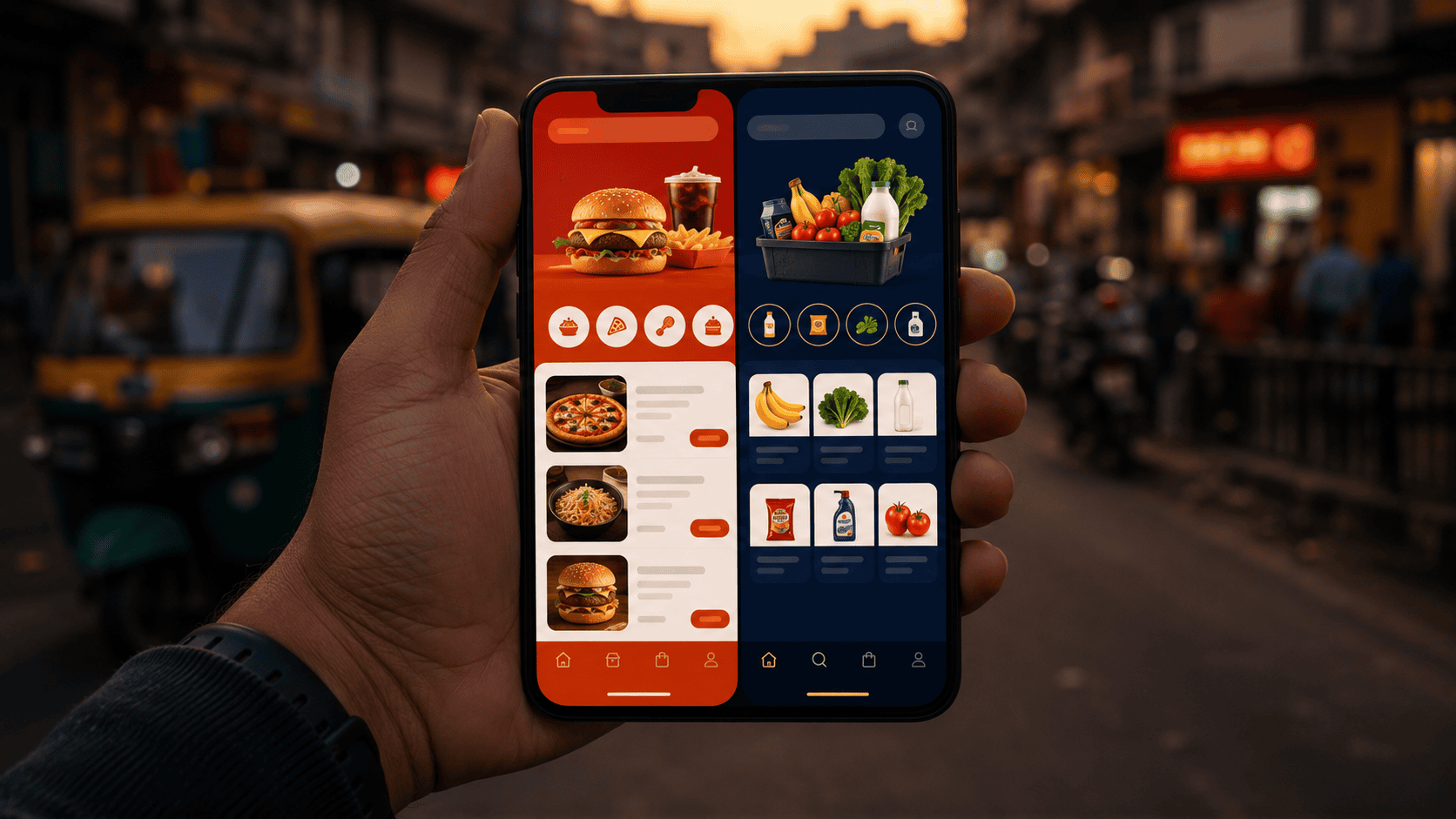
One app, two very different businesses: food delivery and quick commerce, cross-selling off the same trust
The Mistakes
Where People Get SWOT Wrong
-
1Listing everything instead of ranking what matters
A useful SWOT has three to four items per quadrant. Add everything you can think of and you lose the entire point of the exercise: forcing yourself to identify what actually matters.
-
2Stopping at the list
SWOT gives you facts, not a decision. A completed SWOT tells you what is true about the business right now. It says nothing about what to do next. That next step is a separate process most people never reach because they treat the grid as the finished analysis.
-
3Filling it in once and filing it away
Markets shift. A SWOT done two years ago, before the quick commerce boom, would look completely wrong for Zomato today. Revisit it, or it stops being useful.
The Checklist
A Practical Checklist: What to Actually List
Notice the pattern below. Every Strengths and Weaknesses prompt points inward, at the company itself. Every Opportunities and Threats prompt points outward, at the market. Keeping that pattern consistent is what stops the internal versus external mixing that trips up most first attempts.
- What do we do better than competitors?
- What resources do we have that others don't?
- What is our cost advantage?
- What do customers consistently praise us for?
- Where do we lose customers or deals?
- What do competitors do better than us?
- What resource are we short on?
- What do customers complain about?
- What market segment is growing?
- What regulation or technology shift favors us?
- Is a competitor struggling or exiting a space we could enter?
- Who is entering our market or copying us?
- What regulation could hurt us?
- Could a competitor out-price or out-innovate us?
The Reality Check
When SWOT Helps and When It Falls Short
SWOT is genuinely good at fast team alignment, forcing internal versus external clarity, and quickly onboarding someone new to a business built to scale. It is worth being just as clear about where it struggles.
-
1No sense of magnitude or timing
A minor Threat and a company-ending Threat look identical on the page. The grid does not tell you which one to worry about first.
-
2It is subjective
Two people filling in the same company's SWOT will produce different lists. That is not a flaw you can fix, it is a limit you should account for.
-
3No built-in ranking
It does not tell you which item matters most. Experienced strategists pair it with something like TOWS, matching Strengths to Opportunities and Weaknesses to Threats, or simply rank each list by impact before acting on any of it.
Our breakdown of the PESTLE framework is a good companion read if you want the external-factors side covered in more depth.
Use SWOT as the start of a conversation, not the end of one. Keep each quadrant to three or four ranked items instead of listing everything you can think of.
The moment you finish filling in the grid, ask the one question the framework itself never asks for you: now what do we do about it.
Revisit it periodically. A SWOT filled once and forgotten is a wasted exercise, not a finished one.